When Hogwarts Legacy launched, it shattered records, selling over 22 million copies and fulfilling the childhood dreams of an entire generation. It gave us the castle, the classes, and the combat. But as players explored the Highlands, a single, silent wish echoed through the community: “I wish my friends were here.”
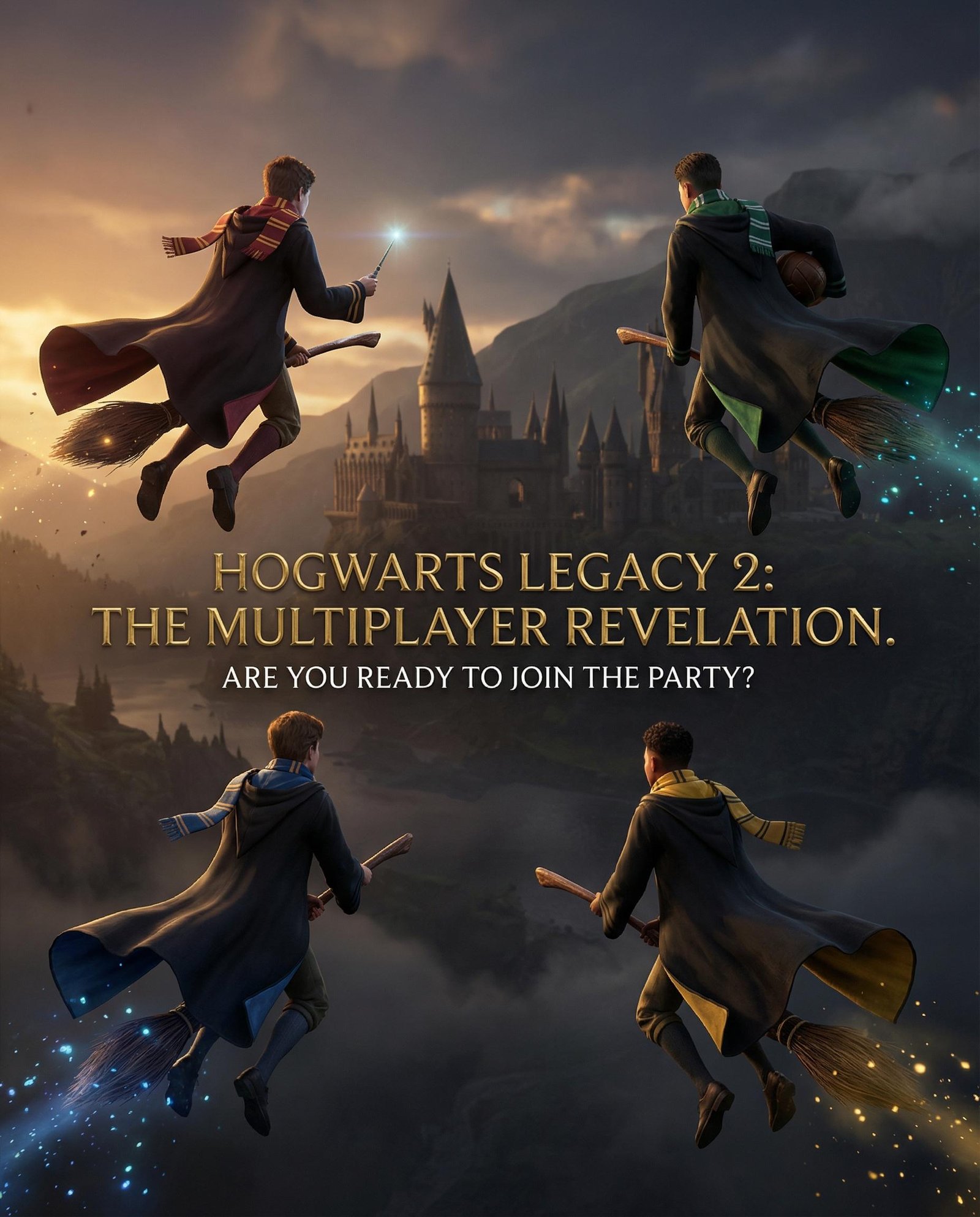
The isolation of being the “chosen one” was the game’s only significant flaw. Now, leaked concepts and swirling rumors suggest that Warner Bros. Games and Avalanche Software are listening. The image circulating the internet—depicting four students, one from each House, soaring toward the castle in formation—signals a massive shift in direction.
This is Hogwarts Legacy 2: The Multiplayer Revelation. Below, we break down everything this potential shift implies, from gameplay mechanics and class systems to the long-awaited arrival of Quidditch.
The “Squad” Dynamic: 4-Player Co-Op Integration
The promotional art doesn’t just show multiplayer; it specifically depicts a quartet. In gaming, the “four-player squad” is the golden standard (think Left 4 Dead, Borderlands, or Baldur’s Gate 3). If Hogwarts Legacy 2 adopts this model, it fundamentally changes how the game is played.
In the first game, you were a jack-of-all-trades, mastering every spell and potion. In a squad-based ecosystem, the game would likely pivot toward Role Specialization. The teaser image suggests that House choice might finally impact gameplay stats rather than just cosmetic appearances.
Potential Class Archetypes
- The Gryffindor Duelist: Focused on frontline offense and heavy damage spells like Confringo and Bombarda. They draw the enemy’s attention.
- The Slytherin Curse-Breaker: A stealth and debuff specialist using Disillusionment and the Unforgivable Curses to weaken high-health bosses.
- The Hufflepuff Herbologist: The ultimate support class. Utilizing Mandrakes for crowd control and Venemous Tentacula for area denial, while dispensing Wiggenweld potions to the team.
- The Ravenclaw Savant: A master of control magic. Using Levioso, Accio, and Glacius to freeze enemies in place, setting them up for the Gryffindor’s heavy hits.
Synergy Magic: The Combo System 2.0
The combat system in the first game relied on “juggling” opponents. With multiplayer, the developers have the opportunity to introduce Synergy Magic. This concept involves two players casting specific spells simultaneously to create a new, catastrophic effect.
Imagine a scenario where one player casts Glacius to freeze a troll, while another simultaneously casts Incendio. In a single-player game, this deals critical damage. In a multiplayer engine, this could trigger a “Thermal Shock” explosion, wiping out nearby goblins. These mechanics would encourage communication and tactical planning, moving the game away from button-mashing and toward strategic teamwork.
Finally: The Return of Quidditch
The absence of Quidditch in the first installment was the most controversial omission in the game’s history. Headmaster Black’s “cancellation” of the season was a clever narrative excuse for a technical limitation. However, with a multiplayer framework, Quidditch transforms from a mini-game into a massive selling point.
With real players, Hogwarts Legacy 2 could introduce a PVP Quidditch League. This wouldn’t just be flying through rings; it would be a full-contact sport.
- Seekers: Require high-speed broom handling and precision piloting to catch the Snitch.
- Beaters: Use physics-based mechanics to knock Bludgers into opposing players to drain their stamina.
- Chasers: Rely on passing mechanics and coordination to score goals.
- Keepers: Act as the last line of defense, requiring quick reflexes.
A ranked Quidditch mode could sustain the game’s lifecycle for years, giving players a reason to log in daily even after the main story is complete.
The Open World: Bigger, Darker, Deeper
Multiplayer requires a larger playground. The Scottish Highlands were beautiful, but a sequel needs to expand the borders. The “Revelation” suggests we are leaving the safety of the school grounds more often.
Diagon Alley & London Hub
A multiplayer game needs a social hub—a place where players can show off their gear, trade items, and form parties without the threat of combat. Diagon Alley is the perfect candidate. Imagine walking into Ollivanders to customize your wand while seeing dozens of other players running past toward Gringotts. This social connectivity makes the world feel alive, rather than a static backdrop.
The Ministry of Magic
While we saw a glimpse of the Ministry in the first game, it was a linear mission. A sequel could open the Ministry atrium as a quest hub for high-level “Auror Missions.” These would be raid-like activities where squads are sent to hunt down Dark Wizards or contain magical beasts in instanced dungeons.
The Narrative Challenge: The “Chosen One” Problem
The biggest hurdle Avalanche Software faces is the story. In Hogwarts Legacy, the protagonist possessed Ancient Magic, making them unique. How do you explain four players all having unique powers?
The story will likely shift away from the “Chosen One” trope and move toward a narrative about a “Circle of Magic.” The lore could pivot to suggest that Ancient Magic has fractured, or that a new threat requires a coven of wizards working in unison. This allows every player to feel important without breaking the canon that Ancient Magic is rare.
Unreal Engine 5 and Technical Hopes
Hogwarts Legacy ran on Unreal Engine 4. The sequel is all but guaranteed to utilize Unreal Engine 5 (UE5). This is critical for multiplayer for several reasons:
- Nanite Geometry: Allows for infinite geometric detail. The castle brickwork, the Forbidden Forest trees, and the cloth physics of robes will look photorealistic.
- Lumen Lighting: Dynamic global illumination. Imagine exploring a dungeon with friends where your wand light bounces realistically off wet cavern walls, illuminating threats in real-time.
- Seamless Loading: Multiplayer games cannot afford load screens. UE5 allows for rapid asset streaming, meaning you could fly from the Astronomy Tower to Hogsmeade without a single stutter, even with three friends tagging along.
Live Service vs. Complete Experience
With the introduction of multiplayer comes the fear of “Games as a Service” (GaaS). Fans are wary of microtransactions, battle passes, and subscription models infiltrating the Wizarding World. The success of the first game was largely due to it being a complete, single-purchase package without predatory monetization.
The hope is that Warner Bros. strikes a balance. Cosmetic microtransactions (like unique robes or broom skins) are acceptable to many if it means free updates and new dungeons. However, locking spells or story content behind paywalls would likely cause a revolt in the fanbase. The “Multiplayer Revelation” must remain a game first, and a marketplace second.
Conclusion: A New Era of Magic
The image of four students flying together is a powerful promise. It promises that the days of exploring the Wizarding World alone are over. It promises tactical depth, social connection, and the realization of the ultimate fantasy: attending Hogwarts with your best friends.
While we wait for an official release date—likely not until 2026 or 2027—the speculation alone is enough to cast a Cheering Charm on the community. Hogwarts Legacy 2 isn’t just a sequel; it looks like the game we wanted all along.
What feature do you want most in the multiplayer sequel? A Dueling Club? A Triwizard Tournament? Let us know in the comments below!